

You approve a trade show plan in January, and by September, the numbers look completely different. Managing event budgets under cost pressure demands a different mindset than we needed even three years ago. The math simply changed. You can't ignore it.
Inflation hit the events industry hard. Median all-in exhibitor spending per show reached about $32,400 in 2025, a 14% increase from 2022, according to the State of Trade Shows 2026 report by GoShowHero. You can't just copy last year's spreadsheet, add five percent, and expect it to work. It won't.

Vendors pass their rising operational costs directly to exhibitors. Materials cost more. Labor costs more. Shipping your booth across the country costs a lot more. Every line item is up. When baseline expenses spike, your margin for error shrinks to zero.
The reality of rising exhibit space and travel costs
Exhibit space and travel consume the bulk of your capital before you even design a flyer. You pay a premium just to stand on the concrete. In fact, exhibit space accounts for about 40.5% of total exhibitor spending; it's the largest single cost category, according to the CEIR Exhibitor Spending Report. It's a huge chunk.
Then you've got to get your team there. Moving humans is expensive. The 2026 Business Travel and Meetings Forecast by GBTA and ALTOUR forecasts the cost per attendee per day will increase about 3% to $263 in 2026. Flights, hotels, and per diems drain funds rapidly. Send eight sales reps to Las Vegas for four days? That travel line item often exceeds the booth's cost itself.
Shifting from broad portfolios to fewer, high-impact shows
Smart companies stopped trying to be everywhere. You can't maintain a massive presence at twenty different shows when costs escalate this fast.
Instead, teams consolidate their efforts. They pick the four or five events that actually drive pipeline and skip the rest. This concentrated approach means the stakes for each remaining event skyrocket. A single bad performance can tank your entire quarter. So, what's your plan?
When you bet your budget on fewer events, you need absolute certainty about your trade show lead capture process. You can't afford to fly your best reps across the country just to come back with a stack of unreadable business cards and zero context. That's a waste.
Related: The Ultimate Guide to Trade Show Lead Capture
Why is budgeting important in event planning right now?
Without a rigid financial framework, trade shows become black holes for marketing capital. You're writing checks for drayage, union labor, and badge scanners without knowing if any of it translates to closed revenue.
Budgeting matters because it forces you to justify every dollar against expected pipeline. It stops the default behavior of buying the same 20x20 booth space just because you had it last year. That's not a strategy.
Seventy-one percent of respondents anticipate an increase in cost per attendee, even though budgets won't rise enough to offset inflation, according to the American Express GBT 2026 Global Meetings and Events Forecast. You've got to do more with the exact same—or even less—money.
Protecting profit margins against vendor and operational inflation
Industry experts identify food and beverage and production expenses as primary drivers of rising meetings and events costs in 2026.
Vendors know you're a captive audience once you sign the exhibitor contract. You've got to use the official general contractor for material handling. You've got to use the exclusive provider for internet and electrical. These monopolies lead to massive price spikes. It's a rigged game.
If you don't build a hyper-specific budget, these mandatory operational costs will eat the money you've set aside for actual marketing. You'll end up with a beautiful booth but no budget left to drive traffic to it. Protect your margins. Cap fixed operational costs early and aggressively defend your variable marketing spend.
Addressing the founder visibility pain point at trade shows
Founders hate trade shows. They sign a $40,000 check for an event, send their best sales reps, and then sit in the dark for a week.
Your team meets 100 people on the floor. Monday morning, you ask what they learned. Blank stares. The founder has absolutely no idea which conversations matter. When the reps return, it takes them a week to sort through messy notes, decipher scribbled business cards, and manually type data into Salesforce. By the time the founder sees the pipeline, the leads are cold. This isn't sustainable.
This lack of visibility makes budgeting feel like gambling. If you can't see the exact conversations your team is having, you can't measure lead quality. Without that, you can't calculate your true return on investment.
You need systems that provide immediate transparency. When your reps use offline-mode lead capture on the floor, the data syncs the second they hit hotel Wi-Fi. At Exporb, we built our platform to give founders this exact visibility. They get full control. They see exactly who the team talked to, what pain points were discussed, which accounts are ready for targeted outreach, and what the next steps should be.
How to make a budget plan for an event using a proven framework?
Start with the absolute maximum you're willing to spend. Write that number down. Everything you do from this point forward must fit inside that box. You don't build an event budget by listing everything you want and adding it up. That approach guarantees overspending. Instead, define your hard cap. Then, mercilessly cut until the math works.
Separating fixed, variable, and controllable costs
Your budget breaks down into three distinct categories. You've got to treat them differently.
Fixed costs don't change, no matter how many leads you capture. The floor space costs what it costs. Your booth structure design is a sunk cost. Lock these numbers in months before the event.
Variable costs fluctuate based on attendance and team size. Bring two extra sales reps? Your travel, lodging, and per diem costs jump. Host a client dinner? The food and beverage bill scales with the headcount. These are flexible.
Controllable costs are where you actually manage the budget. You decide how much to spend on pre-show marketing, whether to rent a monitor or bring your own, or what promotional items to offer. You control these. When operational costs spike, pull money from these controllable categories to balance the sheet.

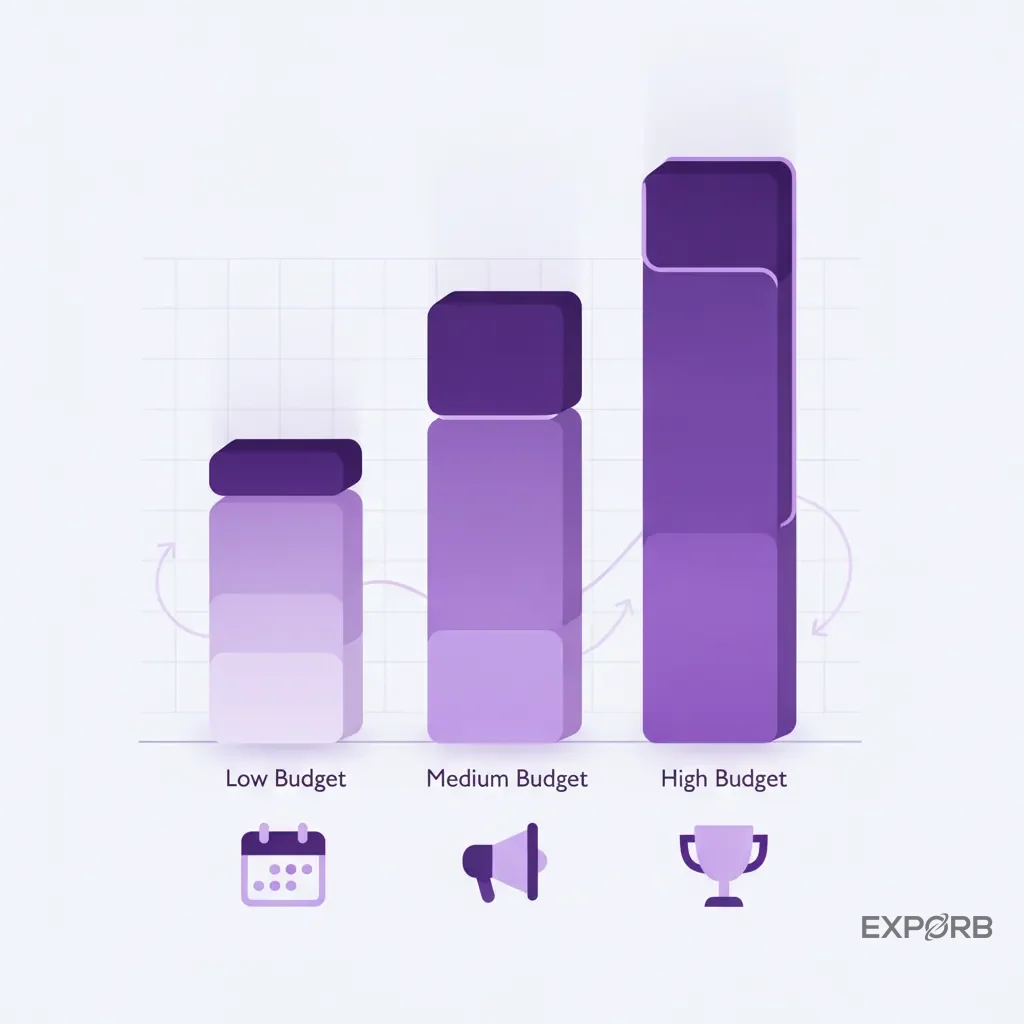
Creating low, base, and high scenarios before committing
Never present a single budget number to leadership. Present scenarios.
The base scenario represents your expected reality. It uses current vendor pricing and historical travel costs. This is your baseline.
The low scenario is your survival mode. What does the event look like if revenue drops and you've got to cut the budget by 30%? Map out exactly what gets cut: usually the large booth space, custom graphics, half the travel team, and any premium services.
The high scenario assumes everything goes wrong with vendor pricing. Union labor takes twice as long. Material handling costs double because your crates were overweight. The Wi-Fi provider charges an exorbitant fee for a hardline connection. Expect the worst.
Building these scenarios prevents panic. When the final invoice from the general contractor arrives and it's 20% higher than expected, you just switch to the high-scenario plan. No surprises.
Example budget scenario planning matrix for a mid-sized B2B event.
Step 1: Define the event objectives and scope
Why are you going to this specific trade show? If the answer is "because we went last year," cancel the booth space right now.
You need a measurable, revenue-tied objective. Brand awareness isn't an objective you can take to the bank. You need concrete targets: 50 qualified meetings, 200 targeted account interactions, $500,000 in generated pipeline, or 10 new strategic partnerships. Be specific.
Aligning event goals with company revenue targets
Every dollar you spend on an event must trace back to a revenue goal.
If your company's primary target is closing enterprise accounts, your event strategy shouldn't focus on scanning 1,000 badges from junior employees. Instead, spend your budget on private meeting rooms, high-end client dinners, flying out your best account executives, and even securing speaking slots. Target wisely.
If your goal is rapid user acquisition for a self-serve product, you need massive foot traffic. Spend the budget on prime floor location, eye-catching displays, quick-pitch demonstrations, and even a live product demo area. Different goals, different spend.
Your goals dictate your budget allocation. A mismatch here wastes capital. Period.

Measuring pipeline efficiency instead of attendance volume
Stop tracking the number of leads you collect. It's a useless metric that encourages bad behavior on the floor.
When you tell reps their goal is 100 leads a day, they'll scan every badge that walks past the booth. They won't ask qualifying questions. They won't discover pain points. They'll just scan and move on. You'll end up with 300 unqualified contacts your sales team will ignore next week. That's a huge waste.
Industry guidance commonly places trade-show cost-per-lead near $486, compared with about $1,038 for an outbound field-sales call, according to CMO Mag. But that $486 figure only matters if the lead is actually qualified. Most aren't.
Measure pipeline efficiency. How many of those conversations turned into real opportunities in your CRM? Did you capture the specific context needed to close the deal? That's the real metric.
This is why relying on badge scanners is dangerous. They give you a name and an email. That's it. Conversation capture, however, gives you intent, pain points, next steps, and budget insights. When your team uses voice notes to record what was actually discussed, you get structured data you can act on immediately.
Step 2: Identify all income sources
Trade shows don't have to be pure expense line items. You can offset the costs if you structure your approach correctly. For event organizers, income identification is the entire business model. But even exhibitors can find creative ways to subsidize their presence. Think outside the box.

Common revenue sources and event sponsorships
If you're hosting the event, your revenue comes from ticket sales, exhibitor fees, sponsorships, and merchandise sales. Analysts project the global large-exhibition market will reach about $51.3 billion in 2026, according to ResearchFDI. There's massive capital flowing through these spaces.
If you're an exhibitor, your "income" usually comes from co-marketing funds. Partner with a larger software company? Ask them for Market Development Funds (MDF). Many enterprise tech companies have budgets specifically designed to help their partners exhibit at industry shows. If you build an integration for a major CRM, that CRM company might pay for half your booth space if you display their logo prominently. It happens.
You can also share booth space. Have a non-competitive partner targeting the exact same buyer persona? Split a 20x20 booth. You'll cut your space and services costs in half immediately. Smart move.
using a tiered pricing strategy for maximum return
For event hosts, tiered pricing protects your baseline while capturing upside.
Sell early-bird tickets at a discount to guarantee enough cash flow for venue deposits. Sell standard tickets to cover operational costs. And sell premium VIP tickets—with exclusive access, dinners, networking, and private sessions—to generate actual profit. Each tier has a purpose.
Exhibitors can use a similar mindset for their budget allocation. Create tiers of investment for different shows. Tier 1 shows get the custom booth, the executive team, the client dinner budget, and premium collateral. Tier 2 shows get the modular booth and local sales reps. Tier 3 shows? Two reps walking the floor with a mobile app. You don't spend Tier 1 money on a Tier 3 show. That's just wasteful.
Related: How to Calculate Trade Show ROI
Step 3: List all expense categories
This is where budgets fall apart. Planners forget about material handling. They forget about union minimums. They also forget that the venue charges $150 a day just to plug in a laptop, and then there's the carpet. You've got to itemize every single expense. Group them logically. That way, you can track variances as vendor quotes come in.

Venue costs and the 40 percent exhibit space rule
Space is expensive, but it's predictable. You know exactly what the 10x20 footprint costs when you sign the contract.
GoShowHero data shows exhibitors typically allocated 25–35% of their budget for exhibit space in 2025. If you spend significantly more than a third of your budget just renting the concrete, you won't have enough capital left to actually execute a marketing strategy. That's a red flag.
Don't buy a massive booth just for ego. A 10x10 space packed with engaged buyers is infinitely more profitable than an empty 20x20 space. Size isn't everything.
Food, beverage, and audiovisual inflation drivers
Seventy-three percent of planners identified food and beverage as one of the two largest costs affecting event budgets, while 66% identified audiovisual, based on an industry survey by Meetings Today.
Coffee at a convention center costs $100 a gallon. A basic monitor rental? $800 for three days. These costs are absurd, but they're the reality of the industry. You've been warned.
You beat these costs by minimizing your reliance on them. Skip the in-booth catering. Take your high-value prospects to a nice restaurant down the street; the food's better and costs half as much. Or, buy a TV from a local big-box store, use it for the show, and donate it to a local charity afterward. You'll save money. Be resourceful.
Marketing, staffing, and technology investments
Trade Show Labs estimates about 14% of a trade-show budget covers employee travel and lodging expenses, according to their data.
You've got to fly them, house them, feed them, and provide ground transport. But the real cost? Their time out of the field. That's lost selling time. If a rep spends three days at a show and two days typing notes into Salesforce, you've lost a week of their selling time. That's precious.
Technology investments should focus entirely on getting that time back. Spend 3-8% of your budget on tools that make the other 92% effective. It's an investment.
Standard trade show budget allocations and their associated financial risks.
Step 4 and 5: How do you factor in contingency and estimate costs accurately?
You'll get hit with a surprise bill. It happens at every single event.
Sometimes a shipment gets delayed, and you've got to pay expedited freight. Union labor takes three hours longer than quoted. You might also forget to order carpet padding and have to buy it at a 300% markup on the show floor. These issues are common.
If you don't build a contingency fund, these surprises destroy your profit margin. Don't let them.

Reserving contingency for high-risk services and freight
Add a flat 15% contingency line to your total budget. Don't allocate this money. Don't tell your team it exists. It's there to absorb the impact of vendor monopolies.
Freight and material handling (drayage) are the highest-risk categories. General contractors charge by weight, usually in 100-pound increments, with strict minimums. Ship a 10-pound box of brochures separately from your main crate? They might hit you with a 200-pound minimum charge for that single box. It's brutal.
Mitigate this by consolidating every single item onto one pallet before shipping. Never ship multiple small packages to a show site. Ever.
Using industry benchmarks to estimate costs accurately
Don't guess. Use historical data and industry benchmarks to build your estimates.
If a venue charges $150 per hour for electrical labor, and you know from last year that your booth takes four hours to wire, put $600 in the budget. Don't assume you can do it in two hours this year. That's a rookie mistake.
Call vendors early. Get written quotes for AV, internet, lead retrieval hardware, and even signage. Lock in your hotel blocks nine months in advance before prices surge. The later you wait to estimate these costs, the more you'll pay. Act fast.
Step 6: Why should you use event budget templates and free tools?
You can't manage a $50,000 budget in your head. You need a structured system to track estimated costs, actual quotes, and final paid invoices. Templates force discipline. They include line items you probably forgot about, like post-show booth cleaning or lead retrieval software licenses. Don't miss a thing.

Standardizing financial tracking across your event portfolio
When you use the same template for every show, you can finally compare performance accurately.
Look at your Q1 event in Orlando. Compare its cost-per-lead directly against your Q3 event in Chicago. You'll start to see patterns. Perhaps shipping heavy structures to the East Coast kills your ROI. Then you transition to lighter, fabric-based booths. Data drives decisions.
Standardization allows data-driven decisions for next year's budget. It's that simple.
Managing cost pressure event budgets with free tools
You don't need a massive enterprise resource planning system to track event costs. Google Sheets works perfectly fine for most teams.
Create a sheet with columns for Category, Line Item, Estimated Cost, Quoted Cost, Final Cost, and Variance. Set up conditional formatting so any variance over 10% turns bright red. Instant alerts. Update this sheet every time you sign a vendor contract. Don't wait until after the show to reconcile. By then, the money's already gone. Too late.
How do cost pressure event budgets improve lead conversion rates?
Constraint breeds focus. When you have unlimited money, you waste it on flashy gimmicks that don't drive revenue. When costs rise and budgets tighten, you're forced to fix the core mechanics of your sales process.
You stop caring about how many people grabbed a free pen. You start caring about how many high-intent conversations your reps logged. That's the shift.
Challenging the misconception that Booth Design matters more than lead capture
Most exhibitors spend $50K on booth design and $0 on lead capture strategy. That's backwards.
A massive LED wall might stop someone in the aisle, but it doesn't close a deal. The conversation your rep has with that person closes the deal. If you don't have a system to capture those details, you just wasted $50,000 to have a nice chat. What a shame.
You need to shift budget away from the physical structure and toward data capture. Equip your team with tools that actually work on the floor. Convention center Wi-Fi is notoriously terrible. If your lead capture app requires a constant connection, it'll fail when the hall gets crowded. You need software that captures data locally. We built Exporb with this in mind: your team scans cards and records voice notes directly on their device. It syncs automatically when they get back to the hotel. No lost data. No spinning loading wheels. It just works.
Calculating fully loaded cost-per-qualified-lead
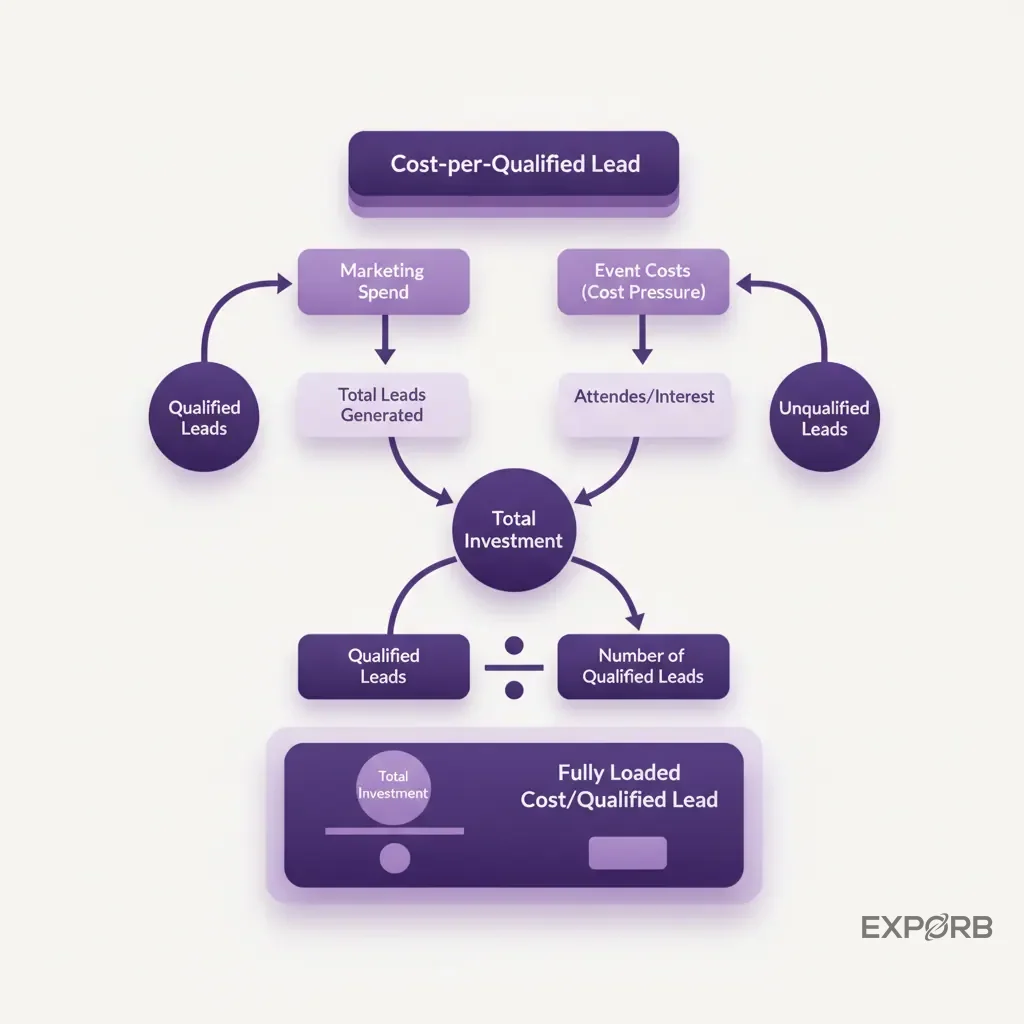
You've got to calculate your true cost. Take your total event spend—including travel, salaries for the days out of office, vendor costs, and even marketing collateral—and divide it by the number of qualified leads that entered your CRM.
Spent $40,000 and got 400 badge scans? Your cost per scan is $100.
But if only 40 of those scans represented qualified buyers, your fully loaded cost-per-qualified-lead is $1,000. Big difference.
When you understand this math, you realize that improving lead quality by just 10% completely changes the ROI. Improve quality by capturing context. You need more than just a name. You want their specific pain point, their current vendor, their buying timeline, and their budget. That's true value.
Five practical steps to manage an event budget without the chaos
Managing a budget means more than just tracking expenses. It's about optimizing your team's workflow so they can focus on selling, not administrative tasks.

Real cost pressure event budgets examples from small teams
Small teams survive by being ruthless with their time.
Consider a three-person startup exhibiting at a massive industry show. They can't afford a $10,000 custom booth. So they don't buy one. They buy a 10x10 space, use a simple branded backdrop, focus 100% of their energy on high-quality conversations, and even bring their own monitors. They don't rent the venue's $500 badge scanner; they use their own phones. They don't spend a week after the show typing up notes; they capture everything digitally on the floor. Because their operational costs are so low, they only need to close one deal to make the event wildly profitable. That's lean.
The turning point: When spreadsheets stop working
Spreadsheets are great for tracking expenses, but they're terrible for tracking people.
When your team drops 200 business cards into a fishbowl, a spreadsheet won't help you figure out who is who. It won't remind you that John from Acme Corp specifically asked about your new enterprise feature. Context is king. When you rely on manual data entry, leads decay. The faster you follow up, the higher your conversion rate. Wait five days to send an email because you're still typing data into Excel? Your competitor already won the deal. Speed matters.
Upgrading to AI-powered CRM tools like Exporb
You don't need to manually type 'nice to meet you' emails late at night in your hotel room. When your team uses automated email follow-up tools, the AI drafts a personalized message right at the booth using the captured conversation context. Just review and hit send. Your team completes the follow-up before you even leave the exhibit hall. That's efficiency.
Founders and sales leaders also need real-time visibility. You shouldn't have to text your reps to ask how the show is going. At Exporb, with team collaboration has, leaders see exactly who talked to whom in real time. You see the pipeline building while the event is still happening. Full transparency.
Managing event budgets under cost pressure ultimately comes down to one principle: eliminate waste. Waste in your vendor spend, waste in your travel logistics, waste in your lead capture process, and waste in your follow-up. Structure your data from day one. Stop losing the leads you paid so much to acquire. It's time to get serious. Your bottom line depends on it.