
Your team just got back from a massive industry trade show. They scanned 400 badges, handed out 1,000 branded pens, and returned with a spreadsheet full of names. You email those names on Monday. Crickets. You just experienced the failure of traditional event marketing.
Community-led event marketing fixes this broken model. Instead of treating trade shows as a numbers game where you collect countless random emails, treat them as physical meeting grounds for your existing and future brand advocates. Focus on shared interests, deep conversations, and long-term relationships. That's how you build real connections.
Moving from one-off lead grabs to lifecycle moments
Trade shows usually operate on a transactional model. Exhibitors want badge scans. Attendees want free swag. It's a terrible exchange of value.
When you shift to a community model, the event becomes a lifecycle moment. You invite your existing users to your booth to share their success stories. You host micro-meetups right on the show floor. You introduce prospects to current customers and let them talk. The goal changes from acquiring a raw email address to pulling a prospect into your orbit.

According to Marketing LTB, 78% of brands say community marketing is essential to their growth strategy. They understand a badge scan means nothing if the person forgets who you're the second they walk away.
Addressing the founder pain point of lost event data
Founders and marketing leaders face a massive blind spot after every event. Your sales reps meet 100 people. They have incredible, deep conversations about pain points, workflows, and industry trends. But you never see that data.
The reps scribble notes on the back of business cards. They dump those cards in a fishbowl. By the time they fly home, they forget everything they talked about. The context is completely lost. You're left with a name and a company, but you've no idea if the person is a highly qualified buyer or a college student looking for a job. This black box makes accurately measuring Event ROI impossible.
Integrating Exporb AI to capture community conversations
You need a way to document these deep interactions without forcing your reps to type on an iPad for ten minutes after every chat. That ruins the natural flow of a conversation.
At Exporb, we built our lead capture app to solve this. Your team doesn't just scan badges. They capture the actual context. After a great conversation with a community member, the rep taps a button and records a quick voice note about what they just discussed. Exporb transcribes that audio, structures the data, and pushes the exact pain points and next steps directly to your CRM. The founder finally gets full visibility into what happens on the trade show floor.
What is community based marketing?
Community-based marketing brings people together around a shared practice, problem, or identity. You don't broadcast your product to a massive audience. Instead, you encourage conversations between the people who actually use your product and the people who should be using it.
Defining the shift toward community-led growth
For the last decade, B2B Marketing relied heavily on outbound sales and paid ads. You bought lists, cold-called, and spammed inboxes. Buyers grew tired of it. Enough was enough. They started ignoring cold outreach and turned to their peers for software recommendations.
This behavior shift forced companies to adapt. Buyers want to talk to other buyers. They want to join Slack groups, attend exclusive dinners, and participate in peer-led webinars. Community-led growth capitalizes on this desire for connection. You build a space where your target audience can learn from each other. Your product simply enables those connections from the center of that platform.

Data backs up this shift. GTM 8020 found that 48% of B2B companies now use community-led growth as a core part of their go-to-market strategy. They realize peer validation closes deals faster than any sales pitch.
Challenging the misconception that booth size beats community engagement
Most exhibitors spend $50,000 on a massive custom booth design. They install flashing LED screens, hire a barista, build a two-story structure, and even install a mini-golf course. Then they spend exactly $0 on their lead capture strategy and zero time thinking about how to engage their community.
That's completely backwards.
A massive booth attracts tourists. People want your free coffee. They don't care about your software. You end up paying a premium to acquire garbage leads.
A 10x10 booth with a highly engaged community strategy will outperform a $50,000 mega-booth every single time. If you invite 50 of your best customers to use your small booth as a meeting point, and they bring their industry peers, you create a high-intent micro-environment. The conversations are better. The intent is higher. You don't need flashing lights when real people validate your product to their peers.
Related: How to turn trade show conversations into pipeline
Why is community based marketing a big idea in marketing now?
Why are B2B brands suddenly obsessed with community? The math simply works better. Traditional acquisition channels are saturated. Cost-per-click on Google and LinkedIn ads increases every quarter. Cold email response rates sit at historic lows. And the noise floor? Deafening. Marketing leaders need a more efficient way to generate pipeline.
Analyzing the 2.1x revenue growth advantage
Building an audience means people listen to you. Building a community means people talk to each other. That peer-to-peer interaction drives massive business value.
Community is a powerful revenue engine, not just a feel-good brand exercise. Omnifunnel's analysis highlights that companies with strong communities grow revenue 2.1x faster than those without. When your users actively help each other solve problems, they become stickier. They renew their contracts, upgrade their tiers, and even become your best salespeople.

Lowering customer acquisition costs by 32 percent
Acquiring a new customer through traditional sales motions is expensive. You pay for the ad click, the SDR to qualify the lead, and the Account Executive to close the deal.
Communities reduce customer acquisition costs by an average of 32%. Your community members act as an extension of your marketing team. They write tutorials, answer questions on forums, and constantly recommend your tool to their colleagues. This organic, word-of-mouth growth bypasses the expensive ad platforms entirely. You acquire highly qualified leads for a fraction of the cost of a Google Ads campaign.
Closing deals 72 percent faster than traditional outbound
Time kills all deals. B2B sales cycles often stretch for six to nine months. Buyers require multiple demos, security reviews, committee approvals, and endless internal discussions.
Community engagement helps deals close 72% faster than traditional sales-led deals. By the time a community member requests a formal demo, they already know how the product works. They've already spoken to three peers who use it successfully. They already trust your brand. The sales rep doesn't have to spend three calls convincing the buyer that the problem exists. They just negotiate the contract and sign the paperwork.
What defines a community in the B2B landscape?
A community isn't your email database, nor is it merely a list of Twitter followers or a passive audience consuming your content. One-way communication creates an audience, not a community.
Moving beyond passive followers to active advocates
In a real community, members interact with each other without your direct involvement. They answer each other's questions. They debate industry trends. They share templates and workflows, and even collaborate on projects.
Your job is to build the infrastructure that allows these interactions to happen. This might be a private Slack workspace, a dedicated forum, or a series of local dinner events. You set the rules of engagement, provide initial value, and then step back. The members must take ownership of the space for it to thrive.

Creating member councils and advisory boards
One of the most effective ways to formalize a B2B community is by creating customer advisory boards. You select 10 to 15 of your most engaged power users and invite them to quarterly strategic meetings.
You share your product roadmap with them. You ask for brutal, unfiltered feedback. You let them test early beta has, and even co-create new has.
This does two things. First, it guarantees you build has your market actually wants. Second, it turns those 15 people into fierce advocates. They feel a sense of ownership over your product. When they attend a trade show, they'll actively pull people to your booth because they helped design the has you're displaying.
How do you build a community-led community from scratch?
You don't need a massive budget to start building a community. You just need a clear purpose and a hyper-specific target audience. Don't try to build a community for "all marketers." Build a community for "B2B SaaS event marketers who run teams of under five people." Specificity drives engagement.
Using free tools for small teams without enterprise licenses
You can validate a community concept using entirely free tools. Start with a LinkedIn group or a free Slack workspace. Invite your top 50 customers.
Don't try to sell them anything. Host a bi-weekly "office hours" call on Zoom where people can bring their biggest challenges and the group brainstorms solutions. Share raw, unpolished insights you won't find on a standard corporate blog. The platform doesn't matter. The value of the conversations matters.

Designing the SPACE framework for community growth
The SPACE framework organizes how a community provides business value.
- Support: Members answer technical questions for each other, reducing your support ticket volume.
- Product: Members provide feature requests and beta testing feedback.
- Acquisition: Members refer new prospects and act as references during sales cycles.
- Content: Members contribute guest posts, case studies, and webinar presentations.
- Engagement: Members build personal brands and deepen their loyalty to your platform.
When planning your community strategy, pick just one or two of these pillars to focus on first. If you try to do all five on day one, you'll fail.
Aligning community growth with trade show pipelines
Your online community should directly feed your offline event strategy. Before a major trade show, look at your community data. Who's attending? Who lives in the host city?
Reach out to your most active members and ask them to co-host a session at your booth. Let them be the star. When prospects walk by and see a real user presenting a case study, credibility is instantly higher than a sales rep doing a generic pitch.
Capture the intent from these sessions. When a prospect asks a great question during the presentation, your team needs to document it. That's where Exporb's team sync dashboard helps. It lets your entire booth staff see who's talking to whom in real time. You can assign a rep to follow up with that specific prospect before the presentation even ends.
Not sure where to start with community-led event marketing?
The transition from traditional exhibiting to community-led marketing feels overwhelming. You still have lead quotas to hit. You still have to justify event spend to your CFO. It's a lot. You can bridge the gap by integrating community tactics into your existing booth workflow.
Pre-segmenting attendees through year-round online groups
Don't wait until the exhibit hall doors open to start marketing. Six weeks before the event, post in your community channels. Ask who's attending. Create a private sub-channel just for event attendees.
Use this group to schedule 1:1 meetings, organize a casual breakfast meetup, share insider tips about the host city, and even coordinate ride-shares. By the time the event starts, you've a pre-qualified group of advocates ready to visit your booth. You're not relying on foot traffic. You've guaranteed appointments.
Designing booth flows for deep community qualification
Change the physical layout of your booth. Remove the massive reception desk that's a barrier between your staff and attendees. Create lounge areas with comfortable seating.
When someone walks in, don't immediately scan their badge. Ask them what they're struggling with. Have a real conversation. If they're a good fit, pull them into a deeper discussion with a product specialist.

Tracking 25 to 40 captured leads per active staff hour
You still need metrics. You should track 25 to 40 captured leads per active staff hour for top-of-funnel greeters at a well-executed booth, according to Exhibition-Stands.eu.
But volume isn't everything. Your demo specialists should aim for 2 to 4 deeply qualified conversations per hour. These are the interactions that actually generate pipeline.
You must capture the details of those 4 conversations perfectly. If the Wi-Fi drops—and it always drops in a crowded convention center—you can't lose that data. That's why Exporb works offline. Your team can scan business cards, record voice notes, snap photos of whiteboard sketches, or even transcribe quick interviews, all without an internet connection. Everything syncs to the cloud the second your device reconnects to a network.
Real examples of community-led event marketing from small teams
You don't need a 50-person marketing department to execute this strategy. Small, scrappy teams often do it better because they can build genuine relationships without corporate red tape getting in the way.
Running community-hosted sessions on the trade show floor
Instead of playing a looping corporate video on your booth monitor, turn your space into a micro-stage. Invite three of your best customers to give 15-minute lightning talks about how they solved a specific industry problem.
Don't let them pitch your product. Let them teach the audience something valuable. Passersby will stop to listen to a practitioner sharing real tactics. Once the crowd gathers, your team can mingle and qualify the listeners.

Using Exporb for offline audio transcription during meetups
Imagine hosting an exclusive dinner for 20 community members after the trade show closes for the day. The conversations are incredible. People are sharing their budgets, their upcoming projects, their biggest frustrations with your competitors, and even their secret strategies.
You can't take notes on a laptop during a nice dinner. It ruins the vibe. But you also can't afford to forget those insights.
We designed the Exporb app for exactly this scenario. After a great chat with a target account, a founder can step into the hallway, open the Exporb app, and record a 30-second voice note. "Just spoke with Sarah from TechCorp. They're ripping out Salesforce next quarter. Budget is approved. Send her the migration case study on Tuesday."
The AI transcribes the audio, structures the action items, and prepares the data for export. The founder gets to enjoy the dinner, knowing the app perfectly handles CRM data.
Implementing account-based marketing through micro-communities
Account-based marketing (ABM) targets specific high-value companies. You can blend ABM with community marketing by building micro-communities around highly specific roles.
If you sell enterprise security software, don't target all IT people. Build a micro-community specifically for CISOs in the financial sector. Host a private, invite-only roundtable for them at your next trade show. These executives won't stop by a loud 10x10 booth to grab a pen. But they will attend a private, peer-to-peer discussion about regulatory compliance.
Related: The ultimate guide to B2B field sales workflows
How does community-led event marketing improve lead conversion rates?
Traditional lead capture creates a massive pile of unqualified data. You scan 500 badges, pass them to sales, and watch SDRs waste three weeks calling people who just wanted a free t-shirt. Community-led marketing pre-qualifies the pipeline.
Benchmarking cost per qualified lead at $300 to $600
Trade shows are expensive. You have to factor in booth space, travel, hotels, and staff time. According to OneIMS, the cost per raw lead at a trade show usually falls between $112 and $180.
But raw leads are useless. The cost per qualified lead typically ranges from $300 to $600.
Community-led events drive that cost down. When your existing customers bring their peers to your booth, they do the qualification for you. The prospect arrives with high intent. You spend less time filtering out bad fits and more time advancing real opportunities.
Comparison of performance metrics between traditional and community-led event marketing models
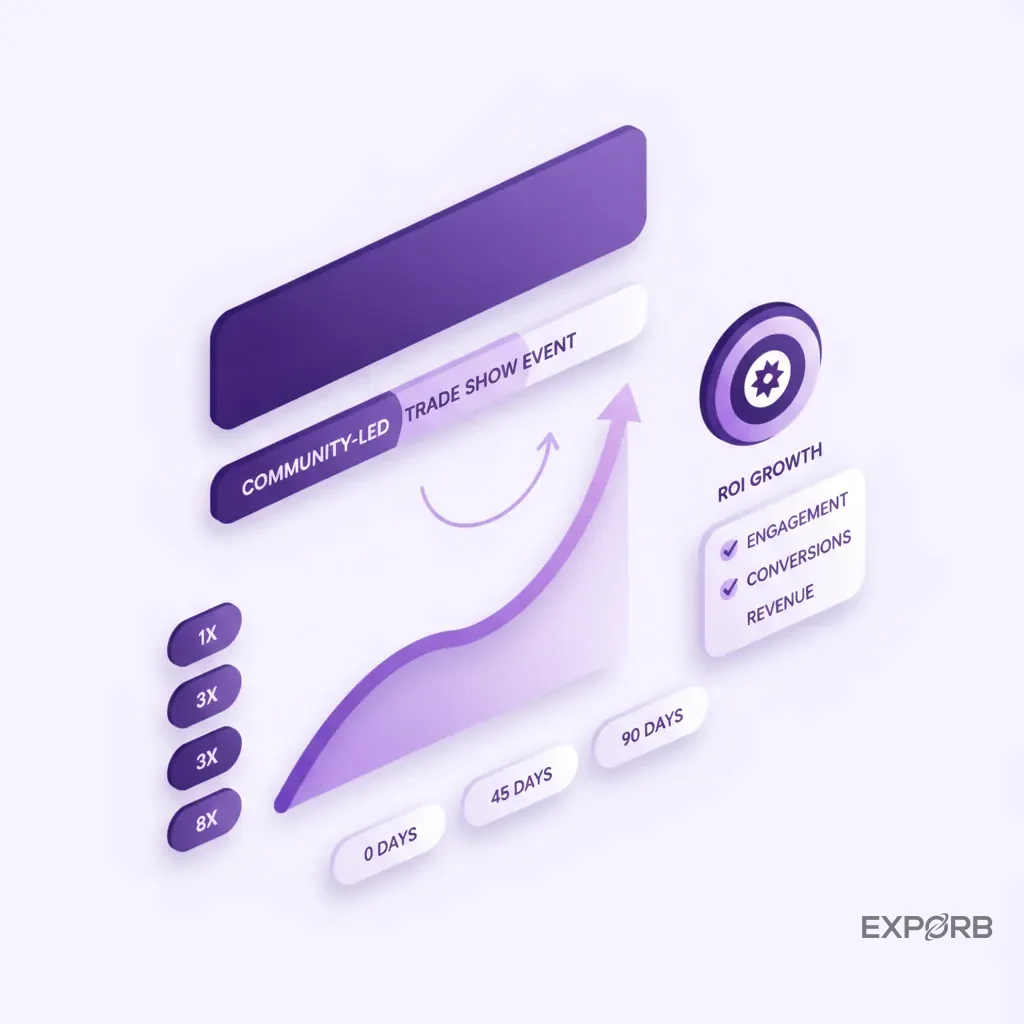
Achieving 3:1 to 8:1 pipeline ROI at 90 days post-show
You have to prove that your event strategy actually makes money. You can achieve a 3:1 to 8:1 pipeline ROI within 90 days of your event with a strong B2B trade show program.
You hit these numbers by following up faster and smarter than your competitors. Most teams wait a week to send a generic "nice to meet you" email blast. You can beat them.
At Exporb, we know speed matters. That's why the app drafts personalized follow-up emails right at the booth. Because the app captures the actual context of the conversation, the AI can insert the specific pain points you discussed into the email template. You review the draft, hit send, and the follow-up is completely done before you even leave the exhibit hall.
Encouraging connections through community leader journeys
Building a community requires human empathy. You can't automate relationships. You have to study the people who successfully shifted their organizations from transactional marketing to relational community building.
How Diana Morgan won community professional of the year 2021
Diana Morgan built her reputation by focusing on the people behind the software. She understood community members don't log into a forum to read corporate press releases. They log in to feel seen, heard, supported in their careers, and connect with peers.
Her strategy focused heavily on recognizing and raising the profile of power users. When you highlight your members' achievements, you build fierce loyalty. This translates directly to the trade show floor. When Diana's community members attended events, they actively sought out her company's booth to connect in person.

Building connections through community with Liselotte Peterson
Liselotte Peterson's approach emphasizes the importance of cross-functional alignment. A community isn't isolated within the marketing department. It must connect to product, support, sales, and even engineering.
When a community member shares a frustration about a workflow, the product team needs that feedback immediately. When that same member attends your user conference, your sales team needs to know their history. This requires strict data hygiene and structured contact management.
Encouraging connections through Tarun Bansal's management journey
Tarun Bansal advocates for treating community management as a distinct discipline, separate from traditional social media management. Social media is a broadcast channel. Community is a facilitation channel.
Bansal's work shows you must measure community health differently than you measure marketing campaigns. You don't track impressions or clicks. You track active contributors, peer-to-peer response times, the number of members who transition into brand advocates, and successful problem resolutions.
Next steps to operationalize your community-led event marketing
You know the traditional trade show playbook is broken. You know spending thousands of dollars to collect random business cards in a fishbowl doesn't generate revenue. It's time to change your workflow.
Start by defining the core purpose of your community. Pick one segment of your audience and build a space just for them. Before your next event, invite those members to meet you in person.
When you get to the show floor, stop scanning badges blindly. Have real conversations. Document those conversations accurately. We built Exporb's CRM export has so you can push structured, enriched data directly into HubSpot or Salesforce. This gives founders the visibility they need to measure actual event ROI.
Sign up to our community newsletter for ongoing insights
Building a modern event strategy takes time. We constantly analyze what works on the trade show floor and share those tactical breakdowns with our network. Join the newsletter to get practical, no-fluff advice on lead capture, CRM hygiene, event ROI measurement, and follow-up best practices delivered straight to your inbox.

Share this post and explore more from the blog
If your marketing team is still arguing over booth design while ignoring lead capture strategy, send them this article. It's time to fix the fundamentals. Explore our other guides on structuring trade show data and eliminating manual data entry.
About the author and related content categories
Our team builds tools for founders and event marketers who are tired of losing leads to messy spreadsheets. We focus on offline-first capture, AI enrichment, immediate follow-up, and automated CRM updates. Check out our deep dives into field sales tactics, trade show planning, advanced contact management, and event ROI analysis.