
What is experiential sponsorship activation?
Event budgets are shifting. EventTrack 2026 reports that 86% of B2B marketers plan to increase event spending this year. But they’re not just buying more floor space. They’ll keep the actual number of events flat, instead concentrating investment on higher-impact experiences. Better data and stronger relationships drive this shift.
Slapping a logo on a lanyard doesn't generate pipeline. To get real ROI, you need experiential sponsorship activations. These are dedicated, interactive spaces or programs where attendees actively participate with your brand, rather than just walking past your signage.

Defining modern sponsorship marketing
Modern sponsorship marketing treats the physical event space as a data collection point. You pay for access to a specific audience. The activation is how you extract value from that access. Ten years ago, sponsorships were pure brand awareness plays. Today, they function as high-intent Lead Generation engines.
You build an environment that solves an attendee's problem. In exchange, they give you their time, their context, and their contact information. That's a fair trade.
The role of experiential marketing in 2026
We're seeing a massive divide form right now. Some companies still rent a 10x10 booth, set up a pop-up banner, and scan badges. Other companies build diagnostic lounges where attendees get real-time assessments of their business problems.
The data backs this shift. Research from Cvent shows 33% of B2B marketers say events and experiential marketing are among their top three areas for increased spending in 2026. They recognize that passive attention is virtually worthless. Active participation is the only metric that matters.
Unlocking the power of experiential sponsorship activation
You unlock this power by connecting physical interactions to digital follow-up. A great activation gets people talking. But if you don't capture the details of those conversations, the activation fails. It's that simple.
Your team meets 100 people at your sponsored lounge. Do you know which ones have immediate budget? What specific pain points did they mention? If you just scan their badge, you've got a list of names. If you capture the conversation, you've got a pipeline.
Related: How to build a trade show lead capture strategy
What are the benefits of experiential sponsorship activation?
You don't spend $50,000 on an activation just to look good. You do it to drive specific, measurable business outcomes. The benefits compound when you move away from passive sponsorships and into active, experiential models.

Increased brand awareness and enhanced brand reputation
People ignore logos. They remember experiences. When you sponsor a high-value activation—like a headshot station with professional styling or a quiet workspace with high-speed internet and premium coffee—you associate your brand with utility.
You solve an immediate problem for the attendee. That creates a halo effect around your product. They return to their office remembering that your company made their trade show experience better. This dramatically improves cold outreach response rates later.
Improved customer loyalty through memorable interactions
Your existing customers attend these shows too. A strong experiential activation gives you a physical space to deepen those relationships. You pull them out of the chaotic exhibit hall and into a controlled environment where your account executives can have meaningful conversations about renewals or upsells. It builds trust.
Increased sales and measurable pipeline impact
This is the only metric founders actually care about. Experiential activations drive revenue. According to Revenue Memo, 48% of brands report experiential campaign ROI between 3:1 and 5:1.
Why's the ROI so high? Because the leads are highly qualified. When someone spends 15 minutes interacting with your diagnostic workshop, they reveal their specific business challenges. Your sales team doesn't have to guess what they care about during the follow-up call. They know.
Comparison of traditional sponsorships versus experiential activations
What are the most effective types of experiential sponsorship activation?
Stop handing out branded pens. They end up in the hotel trash can. The most effective activations provide immediate professional value or solve a logistical problem for the attendee.

Diagnostic workshops and peer benchmark sessions
Professionals attend conferences to learn how they stack up against their peers. Sponsor a diagnostic workshop. Give attendees a tablet to answer five questions about their current processes. In return, hand them a custom benchmark report showing how they compare to the industry average.
You just provided massive value. More importantly, you just collected highly specific qualification data on a prospect. That's powerful.
Farmers markets: An effective and unique experiential marketing strategy
This sounds strange for B2B, but it works brilliantly. Instead of a traditional booth, sponsor a "farmers market" style activation in the morning. Bring in local roasters, fresh pastries, and fresh juices.
Attendees are exhausted. They want good coffee. By sponsoring this high-traffic area, your team gets to have relaxed, low-pressure conversations with prospects before the exhibit hall even opens. The guard is down. The conversations are better.
Hosted-buyer lounges and appointment zones
The exhibit floor is loud. You can't have a serious pricing conversation with a prospect while a competitor's mascot walks by. It's impossible.
Sponsoring a hosted-buyer lounge creates a private, VIP environment. You control the space, the seating, and the noise level. This is where deals actually close. It gives your sales team a designated area to pull high-value targets for deep-dive discussions.
Where do experiential activations fail in trade show logistics?
The physical activation looks perfect. The lighting is great. The traffic is heavy. But the execution completely falls apart the moment the attendee walks away.
The pain point of poor post-event follow-up visibility
Most exhibitors spend $50K on booth design and $0 on lead capture strategy. That's backwards.
Your team talks to 200 people at your sponsored lounge. They scan badges. They take a few messy notes on legal pads. They shove business cards into their pockets. What happens next? Nothing. The show ends on Thursday. The team travels on Friday. The weekend passes. By Tuesday, nobody remembers who said what. The follow-up email is a generic "Nice meeting you" blast that gets ignored. The fishbowl of business cards sits gathering dust.
Why founders lose track of what their team discussed
Founders are completely blind to what happens on the trade show floor. You pay for the activation, but you've no idea if the conversations are any good.
You ask your sales director how the event went. They say, "Great, we got 300 leads." But a badge scan isn't a lead. It's just a digital business card. Without the context of the conversation—what the prospect's current tech stack is, what their pain points are, when their contract expires—those 300 leads are effectively useless.
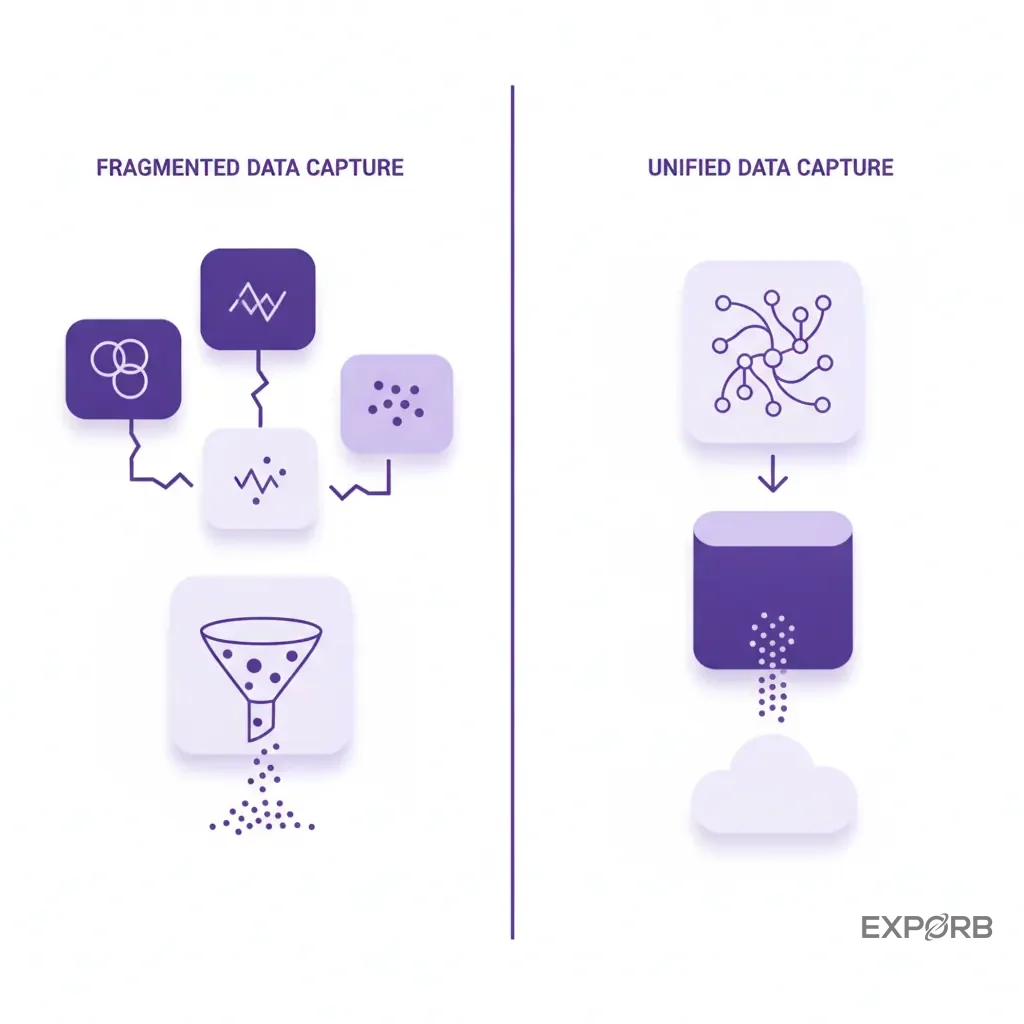
Overcoming fragmented data capture with unified CRM tools
You've got to fix the data capture process at the point of interaction. This is exactly why we built Exporb. Instead of relying on badge scanners that strip away all context, your team can use Exporb's lead capture tools to record voice notes immediately after a conversation.
The app works entirely offline, so it doesn't matter when the convention center Wi-Fi dies. Your team speaks their notes into their phone. When they get back to the hotel, the AI transcribes those notes, extracts the structured data, and pushes it directly into your CRM. You capture the context, not just the contact.
Related: Why offline lead capture matters at trade shows
How are sports sponsorships evolving from static logos to interactive fan experiences?
Renting a billboard in a stadium is a waste of capital. Sports sponsorships are transforming into fully immersive data-capture environments.

Real-world case studies: Large-scale sponsor activations in sports venues
Look at how financial institutions activate in NFL stadiums. They don't just put their name on a gate. They build exclusive fast-track entry lanes for cardholders. They sponsor VIP lounges that require downloading an app to enter.
These brands trade convenience for data. According to PQ Media, the experiential marketing services market is projected to reach $71.22 billion by 2035. Brands are moving money out of static advertising and into physical spaces where they can directly interact with the end user.
Maximizing revenue generation through sponsor activations in sports
Sports teams are actively restructuring their venues to create these spaces because brands pay a premium for them. A static outfield wall sign might sell for $100,000. But a branded, interactive pitching cage on the concourse where fans input their email to get a video of their throw? That sells for $500,000.
The brand gets a massive database of highly engaged local consumers. The team gets higher sponsorship revenue. The fan gets a memorable experience. Everybody wins.
The storymining process: Uncovering brand stories and emotional touchpoints
You can't just drop a product into a stadium. You've got to map the activation to the emotional state of the fan.
If you sponsor a marathon, you don't activate at mile 18 when everyone is miserable. You activate at the finish line with a recovery zone. You mine the specific experience of the audience, identify their highest point of friction, and insert your brand as the solution.
Standout experiential activations: January 2026 industry examples
We analyzed the best activations from the first quarter of the year. The winners all shared one trait: they prioritized deep engagement over mass volume.

Inside Coachella 2026: Where brand activations became cultural architecture
At Coachella, B2C brands stopped building tents and started building infrastructure. Tech companies sponsored massive, air-conditioned charging lounges with secure Wi-Fi and clean seating.
They didn't push product. They provided a heavily demanded utility. In exchange, attendees gladly handed over their contact information and opted into marketing communications. The activation became part of the festival's essential architecture.
Real experiential sponsorship activations examples from small teams
You don't need a million-dollar budget to do this. A small SaaS startup recently sponsored a B2B SaaS conference. Instead of a booth, they sponsored the coat check on the final day.
Attendees were checking out of their hotels and bringing their luggage to the venue. The startup provided secure luggage storage. While attendees waited in line to drop their bags, the startup's sales team handed out coffee and had high-quality, five-minute conversations. It cost a fraction of a booth sponsorship and generated ten times the pipeline.
Applying blue ocean strategy to create uncontested sponsorship spaces
Stop fighting for attention on the main exhibit floor. Apply blue ocean strategy. Find the empty spaces in the attendee journey.
Sponsor the airport shuttle buses. Sponsor the morning run club. Sponsor the hotel keycards. Find the moments where attendees are bored, trapped, or looking for connection, and build your activation there. You'll face zero competition and capture 100% of the attention.
Does booth design matter more than intelligent lead capture?
No. A beautiful booth with a terrible lead capture strategy is just an expensive art installation.

Challenging the myth of the flashy, passive trade show booth
Exhibitors obsess over LED walls, custom flooring, and expensive seating. They spend months debating the exact shade of blue for the backdrop.
Then the show starts. A highly qualified prospect walks in. The sales rep has a great 10-minute conversation. And then... the rep drops the prospect's business card into a fishbowl and promises to email them "next week." The $50,000 booth design did absolutely nothing to advance the sale. It's a common mistake.
Why AI-assisted qualification beats pure aesthetic appeal
The physical space only exists to start the conversation. The capture process is what actually generates revenue. That's the key.
You need to qualify leads instantly. If your rep talks to a VP of Operations with a $100K budget, that person needs a follow-up email today, not next week. If they talk to a student looking for a job, that person goes into a different bucket. Relying on human memory to sort this out after a four-day trade show is a guaranteed way to lose deals.
Integrating Exporb to capture business conversations smoothly
This is where smart teams deploy technology. With Exporb's AI lead scoring, your reps don't have to guess who's hot and who's cold.
The rep takes a picture of the business card. The AI extracts the text with OCR. The rep records a quick voice note about the conversation. The AI analyzes the transcription, identifies the specific pain points discussed, and automatically scores the lead based on your custom criteria. The founder can see the hottest leads appearing on the dashboard in real time, right from their office.
How do experiential sponsorship activations improve lead conversion rates?
When you capture context, conversion rates skyrocket. A generic lead converts at 1%. A highly contextual lead converts at 20%.
Moving beyond anonymous engagement to permission-based profiling
Experiential activations force interaction. When an attendee participates in your diagnostic workshop, they're explicitly giving you permission to review their business problems.
This is fundamentally different from a badge scan at a turnstile. You aren't tricking them into giving you their email. You're trading valuable insights for their detailed profile. The intent is infinitely higher.
Using offline audio transcription for deeper conversation context
The biggest threat to your conversion rate is the convention center Wi-Fi. It always fails. If your lead capture app requires a live internet connection to work, your reps will revert to writing on napkins.
Your tools must work offline. We know convention center Wi-Fi is terrible; that's why with Exporb's voice notes, recording happens locally on the device. Your reps can speak their notes in the middle of a dead zone. The audio files queue up securely. The moment the phone hits the hotel Wi-Fi, the AI kicks in, transcribes the audio, and structures the data. No context is lost.
Structuring unstructured data for targeted follow-up
"Good talk. Wants demo. Call next week."
That's what a typical CRM note looks like after a trade show. It tells the account executive absolutely nothing.
You've got to structure the unstructured data. You need the exact budget, the current software they use, the name of the decision-maker, and the timeline. When you capture this data accurately at the activation, your follow-up becomes hyper-targeted. You aren't sending a generic blast; you're continuing a specific conversation.

Can you build experiential sponsorship activations with free tools?
Yes, but you'll hit a ceiling very quickly. Free tools work for small events, but they break down at scale.

using low-cost digital integrations for small teams
If you only have two reps and expect 50 attendees, you can survive with a free form builder and a spreadsheet. You can set up a QR code on a table that points to a simple survey.
It gets the job done cheaply. But it puts the burden of data entry on the attendee. People hate typing on their phones. If your form has more than three fields, your drop-off rate will be massive.
When to upgrade from free solutions to an AI-powered CRM
You need to upgrade the moment your team is having more conversations than they can accurately remember. If you're losing track of who said what, free tools are costing you money.
Speed to lead is critical. Most teams still type follow-up emails manually after a show. We designed Exporb to draft them at the booth](https://exporb.com/features/email-follow-up) using real conversation context. Your rep picks one of the built-in templates, the AI fills in the prospect's name, the pain points discussed, and the proposed next steps. The rep hits send before the prospect even leaves the exhibit hall.
The business case for sponsor activations: ROI, targeting, and measurement
You build the business case by tracking pipeline, not foot traffic.
According to Event Marketer, 85% of B2B attendees reported feeling more educated after participating in an experiential event. But education doesn't pay payroll. You've got to prove that the educated attendee eventually bought the software.
You do this by capturing the data flawlessly at the event and pushing it directly into your main CRM. When that lead closes six months later, marketing gets the attribution for the sponsorship activation.
Launching your high-impact activation strategy for the year ahead
Stop buying sponsorships based on floor plan location. Start buying them based on the experience you can build.

Designing adaptive, research-driven sponsor activations
Don't guess what the audience wants. Ask them. Before you design your activation, survey your current customers who are attending the show. Ask them what their biggest frustration is with the physical event.
If they say they hate the lack of quiet meeting spaces, sponsor a soundproof pod farm. If they're struggling with a specific new industry regulation, sponsor an ask-the-expert clinic. Adapt the physical space to the researched need.
Core components of story-driven, multi-channel sponsor activations
Your activation shouldn't exist in a vacuum. It needs pre-event promotion, on-site execution, and post-event follow-up.
Email your targets two weeks before the show. Give them a reason to visit the activation. Capture their context perfectly on site. Then, run targeted LinkedIn ads to the specific people you met, referencing the activation. It requires a unified data strategy to pull off.
Measuring success through completed profiles and booked meetings
Throw away your badge scan metrics. They mean nothing.
Measure the success of your experiential sponsorship activations based on two numbers: the percentage of leads with fully completed contextual profiles, and the number of follow-up meetings booked within 48 hours of the event. If you get the physical experience right, and you nail the data capture on the floor, the meetings will book themselves. Stop letting messy data ruin great events. Give your team the tools to capture context, and watch your trade show ROI soar.